



Over time, we have used a lot of terms to distinguish “our part of the world” from “other parts of the world,” that partitioning happening based on extent of development (economic, social, political, etc). During the Cold War, NATO used highly politicized terminology like “first world” and “third world” to categorize capitalist versus communist countries. After the end of the Cold War, these words didn’t disappear. Instead, they evolved:
- “Developed” and “Developing”
- “High-income” and “Low-income”
- “Global North” and “Global South”
No matter the label, the message is the same: we like to differentiate us and them. But what if I told you that some of these “developing” countries may no longer be as “developing” as we once thought? The world has changed a lot in (what feels like) the blink of an eye, and there’s data to prove it.
I got this data from a TED Talk that I watched recently that beautifully explains this nuance (“Let my dataset change your mind” by Hans Rosling, June 2009). Definitely check it out if you’re interested in a highly detailed explanation of the concept. For now, though, let’s just take the examples of Mexico, China, and the United States.
Now if I had to predict public perceptions, I’d say most people would probably categorize Mexico as developing, the United States as developed, and China as somewhere in-between (with different people thinking it leans more one way or the other, based on their definition of what a developed country looks like). Using some of the commonly observed qualities in developed countries—high life expectancy, low birth rates, and high income—let’s see if this is actually true using Rosling’s graphs.
Case Study #1: The United States vs China (life expectancy and income)
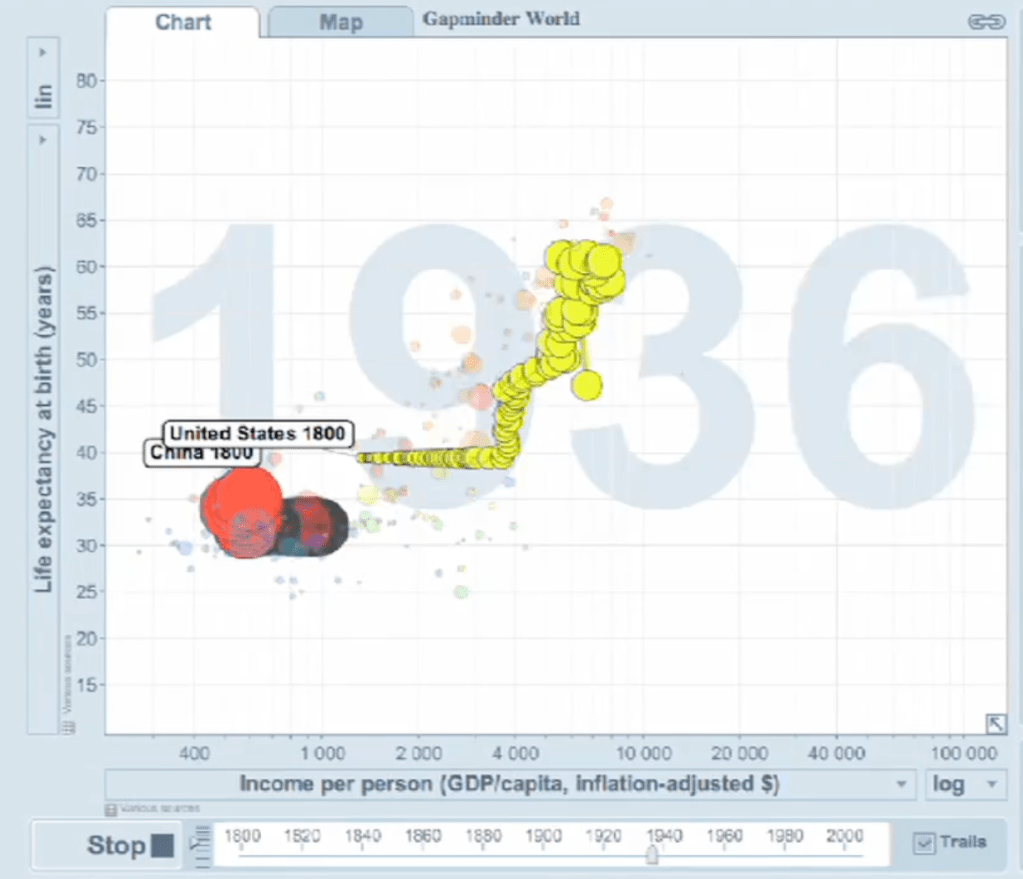
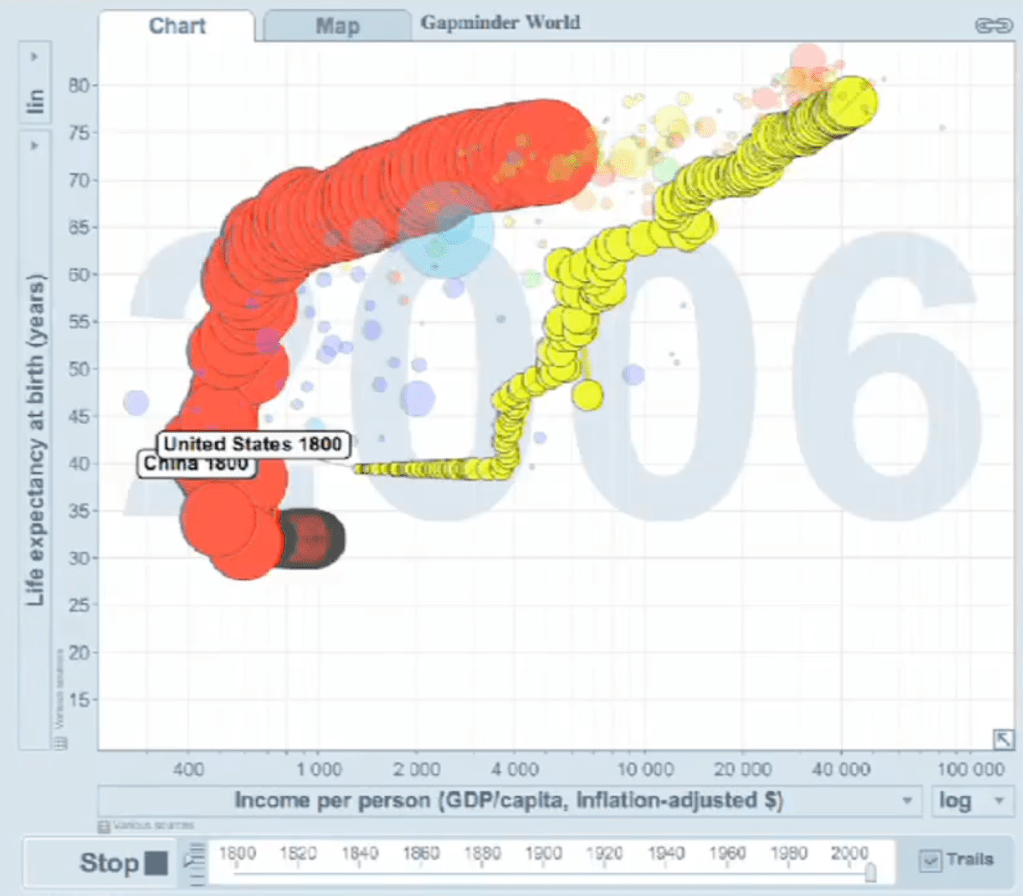
As you can see, in 1936, the United States had both a higher income and a higher life expectancy than China did. But what many people don’t realize is that over the course of the next 70 years, China nearly completely caught up in both metrics. Not only did China catch up, but they continue to keep up, meaning China didn’t just advance their own development to the level of America’s, they actively match America’s rates of development, specifically economic development (as indicated by how China’s graph “chases” America’s graph along the income axis). So can we really keep calling China “developing”? Can we really keep separating their country from what we consider “our level”?
Other interesting observations from this case study:
- America chose to develop its economy first, as seen by its increase in income preceding its increase in life expectancy.
- China, on the other hand, chose to develop its public health systems first, as seen by its increase in life expectancy preceding its increase in economy.
Now, what if we threw Mexico in the mix too, and switch out income for birth rates along the x-axis?
Case Study #2: The United States vs China vs Mexico (life expectancy and birth rates)
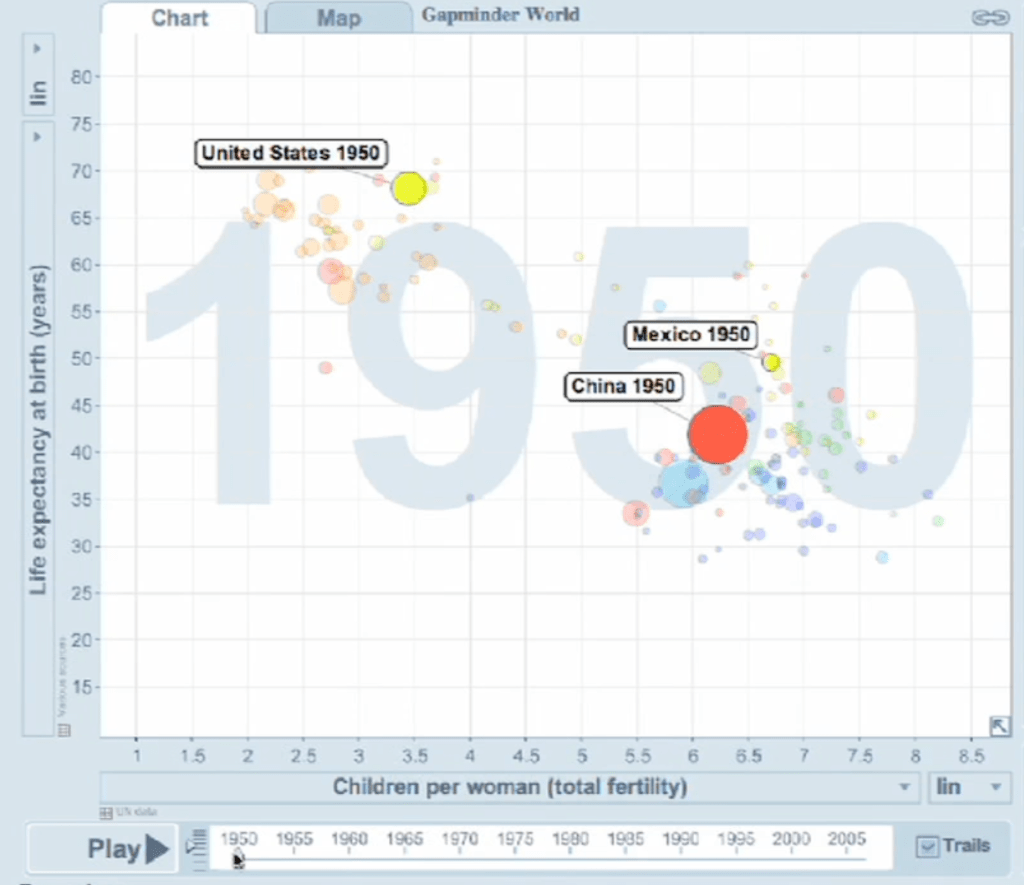
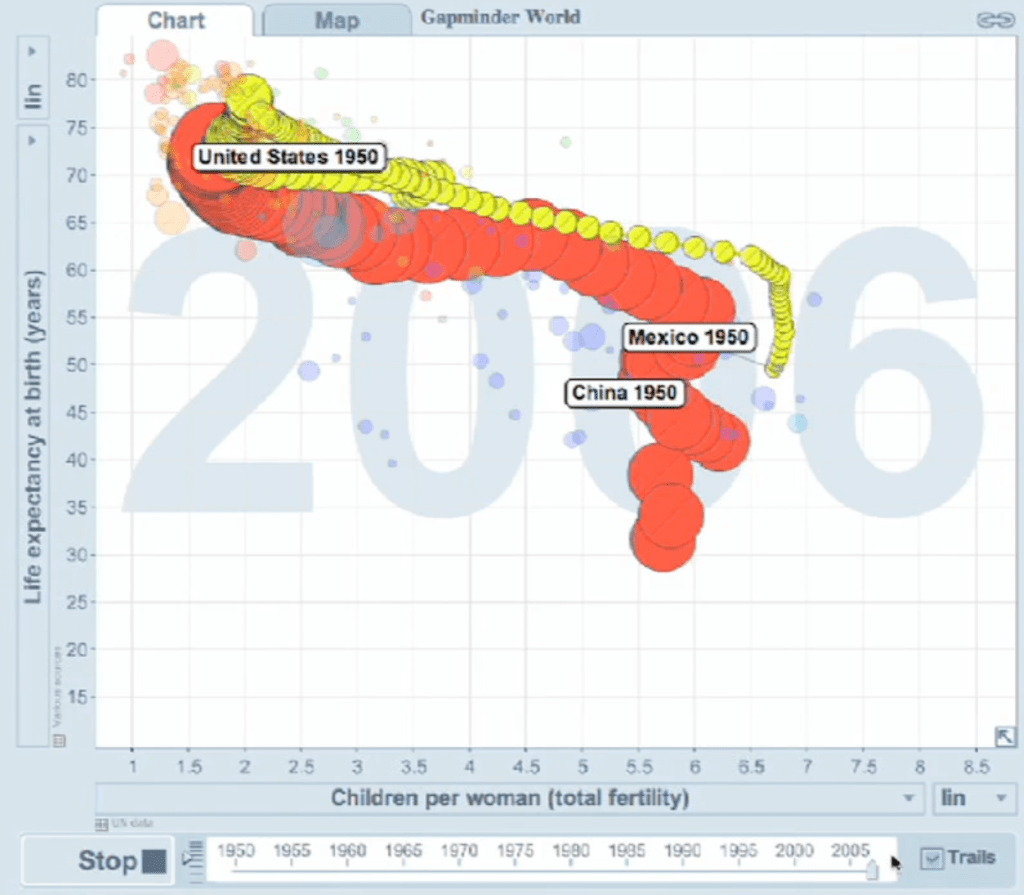
Again, the United States begins more developed than China and Mexico, with a higher life expectancy and a lower birth rate. But by 2006, both China and Mexico catch up. An almost-equal life expectancy and birth rate show the level of progress both China and Mexico have made in population control and public health systems, respectively. And once again, the question begs to be asked: are these countries still “developing”?
I know this isn’t an easy question to answer, and perhaps the question itself oversimplifies the complexity of the topic, but what I will say is this: we need to be more cognizant of the advancements going on around the world. As Rosling explains, a better term for China and Mexico nowadays might be “middle” countries, as opposed to “developing” countries. Furthermore, grouping China and Mexico with the truly developing countries (like those still experiencing widespread poverty, human rights violations, and warfare) is ignorant of all that they’ve been able to accomplish. Rosling’s proffered term both takes into account China and Mexico’s progress over the past many decades, while also acknowledging areas for improvement.
Terminology is tricky, but it’s important to pay attention to nonetheless. We need to make sure we’re updating the words we use to accurately reflect the happenings of the world beyond our borders. The world is catching up, and it’s time our vocabulary did too.
 Aanya Shridhar
Leave a comment