



I recently watched a TED Talk about the inclusion crisis in Hollywood, specifically regarding gender inequality in film (“The data behind Hollywood’s sexism” by Stacy Smith, October 2016). Swift’s study is a perfect example of how data can be used to analyze societal issues, and more importantly, come up with potential solutions for resolution or mitigation.
Swift begins her talk with a summary of her study and the data she collected. Her and her team referenced the top 100 films in 2015 and recorded all instantiations of a female character. In order for a female character to be counted, all they had to do was say at least one word in the movie, which is a pretty low standard for qualification as it is.
From the top 100 films in 2015, she found the following:
- 48 films didn’t have any black/African American females
- 70 films didn’t have any Asian/Asian American females
- 81 didn’t have any females with disability
- 93 didn’t have lesbian, bisexual, or transgender females
- 68 didn’t have a female lead or co-lead
- Females are 3x more likely to be in sexually revealing clothing or partially naked
- The average female waist size in cartoons was sometimes comparable to the circumference of the upper arm
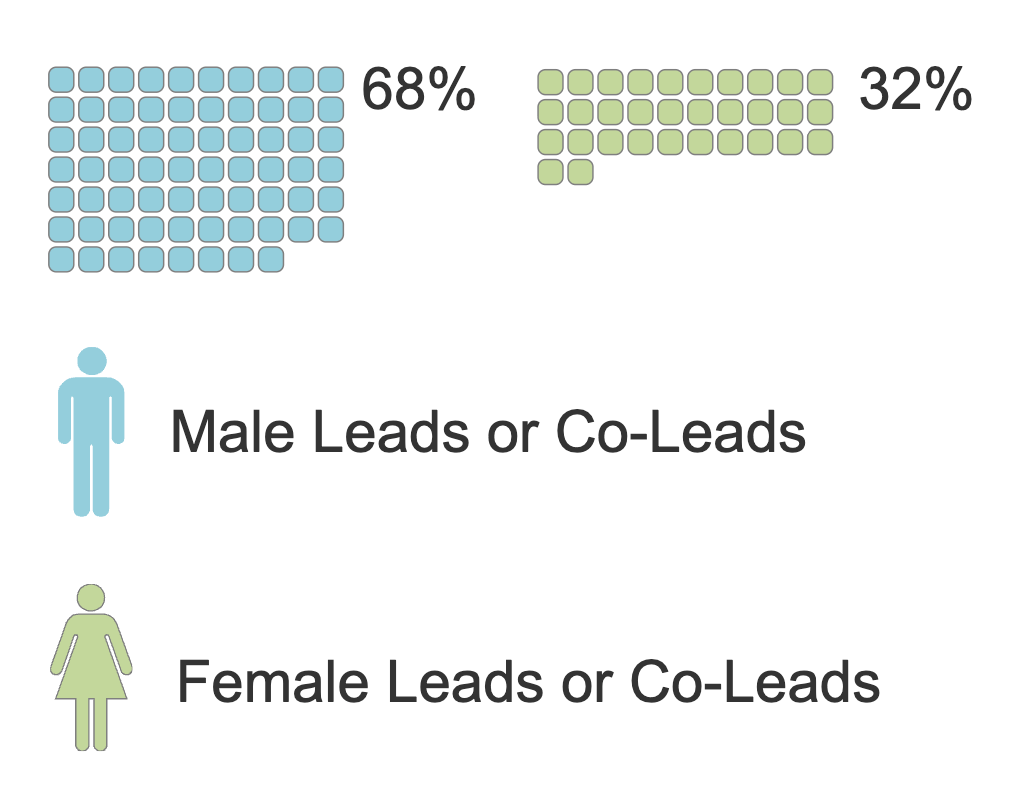
The results show a disproportionate gender representation in Hollywood, especially for LGBTQ+ females and females of disability. 68 films not having a female lead or co-lead is indicative of this skew, since basic logic dictates that in a world with equality, there would be 50 films out of the top 100 with a female lead or co-lead and 50 films with a male lead or co-lead. Furthermore, Swift’s results show the issues of sexualization and fat-phobia that exist within Hollywood. In reference to the waist-to-arm comparison, she jokes, females in cartoons have “no room for a womb or any other internal organ.”
Swift attributes this inequality to two reasons: (1) people within the film industry, regardless of gender, associate the word “director” with males; (2) there is a misperception that women can’t “open films,” meaning they cannot generate revenue when cast as the lead (this has been disproved by high-grossing movies like The Hunger Games and Pitch Perfect).
But what I found most significant about Swift’s talk is that she doesn’t end the analysis with data curation. She takes it a step further, running simulations about what would be needed to bridge the gender gap in film to provide us with actual solutions, instead of just another depressing data point in Hollywood’s record. Swift explains that according to her simulations, adding just five more female speaking characters to each film over the course of three years would allow us to reach gender parity for the first time in over half a century.
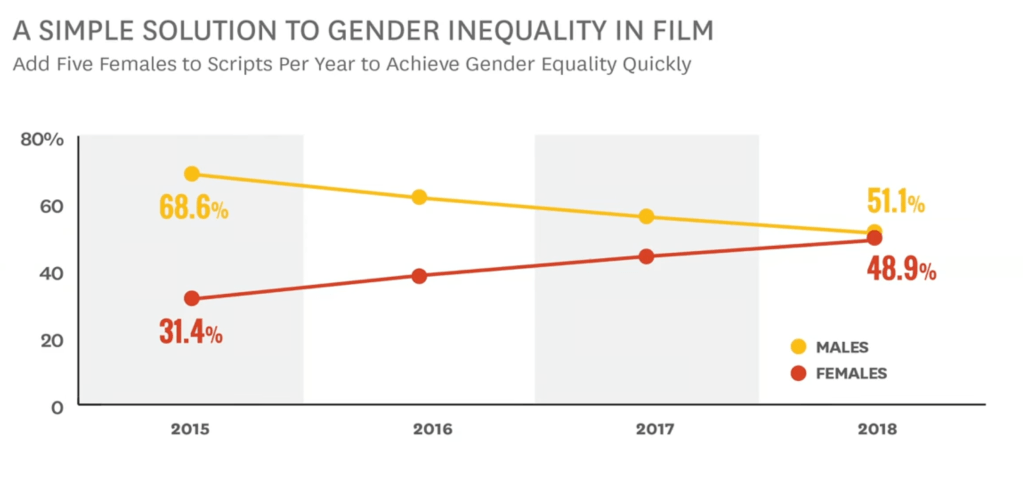
This is what I appreciate most about Swift’s talk: her use of data science, not as an endpoint, but as a starting point of change.
 Aanya Shridhar
Leave a comment